Friday, 28 March 2014

Hello friends, here is the funny trick to view any webpage in 3D mode in your web browser. To view webpage in 3D you need to have installed Mozilla Firefox or Google chrome. After follow this trick you will able to view any webpage in 3D which will amaze you and your friends. This is a simple and small tricks. To do that you don’t need to have any technical knowledge. So check how to view webpage in 3D.


3D view webpage in google chrome:
If you are using Google Chrome as your web browser then you need to install an extension called 3D view for webpages in your browser, because there is no inbuilt features for 3D viewing in chrome.
First of all open your Chrome browser and install the extension called 3D view for webpages.
After adding the extension in your browser, open any webpage.
Now go to top right of your browser and you will see a 3D box icon and just click on it.

3D view webpage in firefox:
Firefox is well known and best web browser in the world. If you are using Firefox then you can use this trick without installing any add-on because Firefox have inbuilt feature called Web console which will help you to view a webpage in 3D. Now follow the steps as given below.
Open Firefox and open any website page such as Google.com, Facebook.com or other as your wish.
After opening full webpage then press Ctrl + Shift + K and it will open Web Console option at bottom of that webpage.
Now go to right side of web console option and you will see a 3D box at top right side. If you hover your mouse on it then it show you 3D view. Just click on that 3D box.

Now your current web page turns into a 3D web page. Now dragging the page with your mouse and you will see the page in 3 dimension.


NOTE: If this option didn't worked for you then install Tilt 3D add-on in your browser and then try to view web page in 3D.
<h1> FREE DOWNLOAD OPTIONS OF YOUTUBE VIDEOS </h1>
FREE DOWNLOAD OF YOUTUBE VIDEOS
YouTube is the most popular video shearing web site. you can get your desired any kind of video inside this web site. but it is a great problem that is this site has no direct video download options. so you can not download any video directly. somebody use some video downloader plugins in there web browser and somebody use some downloader software like IDM to download there YouTube videos. But software or plugins use is not easy way. So, this tutorial I will show you how to download YouTube video without any software or plugins.
Read also:

torrent files to idm

HOW TO DOWNLOAD YOUTUBE VIDEOS

I will show step by step process
Go to any youtube video u want
Then type the "savefrom.net" or "sfrom.net" or "ss" before the url of youtube video like this Example:sfrom.net/http://www.youtube.com/watch?v=3mEjNGh9N5A
u can also use short domain names like
ssyoutube.com
Example:www.ssyoutube.com/watch?v=3mEjNGh9N5A
u can see screenshots like this
now choose the format of the video. it is in the right side of page
download the video

ANOTHER WAY OF DOWNLOAD


Go to
http://www.savefrom.net
then paste the url of youtube video.select the format of video.you can download the video
like follow the screen shots
you are done.
enjoyyy
LIKE OUR PAGE HERE.

funny trick

This is a funny trick

Change the screen upside down type
*#5513#
on the main screen
Change the screen to anti-clockwise direction type
*#5512#
on the main screen
Change the screen clockwise type
*#5514#
on the main screen
Change the screen to its normal mode type
*#5511#
on the main screen
If u have any problem repeat the same code again
This is just for fun
LIKE OUR PAGE HERE.

Thursday, 27 March 2014


What are Basic Disk and Dynamic Disk ?


Basic Disk : Primary Partition,Extended Partition,Logical Drives


Basic Disk and Dynamic Disk are generally the two types of hard disk configuration in Microsoft Windows.A Basic Disk Consists of Primary Partition that is used for the storage of Windows Files , Extended Partition and Logical drives for organizing the data.Basic Disks provides a simple storage solution for storing the files and it supports clustered disks,IEEE 1394 disks and USB Removable Drives.Basic disks makes use of MBR (Master Boot Record) Partition style similar to the disks used by Microsoft MS-DOS Operating Systems.It also supports GPT (GUID Partition table). Most of the Personal Computers makes use of Basic Disks because they are very simple to manage where you can extend your primary partition and logical drives space with simple clicks.

 Some Common Operations applicable to Basic Disk only :


  • You can easily create or delete your Primary and Extended Partitions
  • You can create or delete the logical drives
  • You can format the partitions and make them active

Dynamic Disk : Volume Management


Dynamic Disk consists of large number of dynamic volumes around 2000 that works very similar to the Primary Partitions as used in Basic Disk.Dynamic Disk are mostly used by Advanced IT professionals to increase the performance and reliability of the computer.Dynamic Disks also supports both MBR (Master Boot Record) Partition style and GPT (GUID Partition table) similar to the basic Disks.Dynamic Disk have the ability to create volumes so that can span Multiple Disks.Dynamic Disks provides great Flexibility in Volume management because they make use of database in order to track the information of dynamic volumes located on the disk.Dynamic Disk allows volumes to have a non contiguous extents on one or more physical disks.LDM(Local Disk Manger) and VDS(Virtual Disk Service) are the main basis of Dynamic Disks and its volumes providing you with features to change Basic Disks into Dynamic Disks or Vice-versa and allows you to create fault-tolerant volumes.

Some Common Operations applicable to Dynamic Disk only :


  • You can create and delete all types of volumes like Simple,RAID-5,Mirrored,Spanned,Stripped
  • You can easily extend any Stripped or Spanned Volume
  • Repair any Mirrored or RAID-5 Volumes
  • You can Reactivate any missing or offline Disk

Common Operations Applicable to Both Basic Disk and Dynamic Disk:


  • Both of Basic Disk and Dynamic Disks supports MBR (Master Boot Record) Partition style and GPT (GUID Partition table)
  • You can Check Disk properties in both Basic Disk and Dynamic Disks like – Free space,Capacity,Current Status etc
  • Convert Basic Disk into Dynamic Disk or Convert Dynamic Disk into Basic Disk
  • Create Drive Letters in both Basic Disk and Dynamic Disks for the partition or disk volumes and for CD/DVD-ROM
  • View Partition Properties (like offset, length, type etc) as well as Volume Properties (like label, type, Win32 path name etc)

Basic Disk and Dynamic Disk Difference : Major Differences


  • Dynamics Disks are supported with Multipartition Volumes where you can create the volumes whereas Basic Disks do not possess this property
  • Basic Disk Partition Information is stored in the Windows Registry Whereas Dynamic Disks Information is stored on the disk itself
  • Dynamic Disk Volumes consists of noncontinuous extents on one or more physical disks


Windows 7 provides Flexible options for the conversion of Basic Disk into Dynamic Disk using the Disk Management Utility Software.Before You convert Basic Disk into Dynamic Disk you must Note the Following Points.Basic Disks are mostly used in Personal Computers whereas Dynamic Disks are used in IT Industry field related computers.Know more about What are Basic Disk and Dynamic Disks ?

Points to Remember Before Converting Basic Disk into Dynamic Disk :


1) Make Full Back-up of your hard disk before you convert it to Dynamic Disk


2) After Converting Basic Disk into Dynamic Disk Windows 7 will Read it but it may happen that other operating Systems will not read it and this process is irreversible
3) Some Portable Computers don’t Support Dynamic Disks


4) If you want to change the format of the disk and want to return back to basic then you should need to create back the partitions on the drive again

Follow these steps to Convert Basic Disk into Dynamic Disk

1) First of all you need to open Disk Management Utility in Windows 7.To open it follow the below given steps


  • Go to Start and then Go to Computer and then do a Right-click there and select Manage as shown below
           Start->Right Click Computer -> Select Manage
  •  Now a new Window will open and there select Disk Management as shown below
  •  Now Select the Disk that you want to convert it to Dynamic Disk and Right Click on that disk as shown below
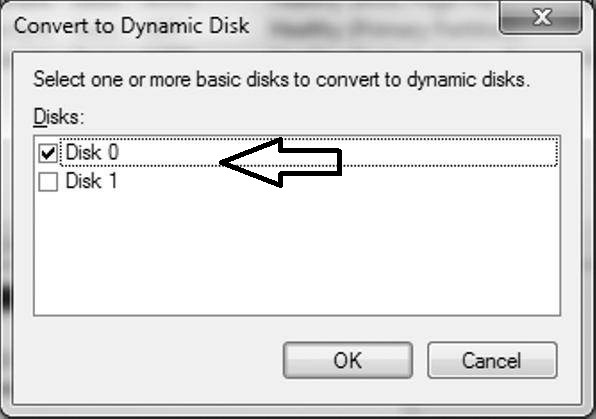
  •  Mark the Disk that you want to convert and Click OK
  •  Again a new Window will open showing you the disk that you have selected to convert and there click Convert
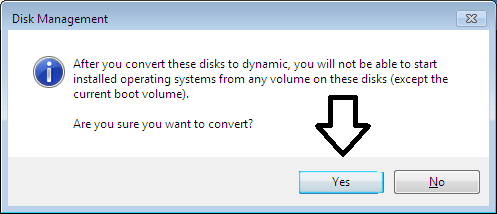
  • Now a Warning Message will appear stating that you will not be able to start installed operating systems from any volume on these disks(except the current boot volume) as shown below
  • Click on Yes and You are done
  • You have Successfully changed your Basic Disk into Dynamic Disk


* If during Conversion you encounter an error like this”Pack name is invalid” then here is a simple fix to solve this error


This is a very common problem that is faced by most of the users while using the Disk Management Utility in Windows Vista , Windows 7 or in Windows 8.You might face an error like “pack name is invalid” while converting Basic Disk into Dynamic Disk using the Windows Disk management Utility and is a very known common Microsoft Windows issue. Basic Disk and Dynamic Disk are the type of hard disk configuration in Microsoft Windows. A Basic Disk makes use of Primary partition for the storage of Windows files , Extended Partitions and logical drives for organizing the data whereas Dynamic disk consists of large number of dynamic volumes about 2000 volumes that works like Primary partition Drives as use on Basic disks. Generally personal computers uses Basic Disks whereas Dynamic disks are used in IT industries by professional users. “pack name is invalid” error generally occurs when you use NON-ASCII characters for your Computer’s name and thus this error is commonly found in Countries like China or Japan. Also found in Korean computers because they generally tend to use NON-ASCII characters. You may also face this error while using one or more double-byte characters. Therefore Microsoft Recommends using only ASCII characters for the name of your computer or files or folders etc. So here is a simple solution to solve this error and hence convert your basic Disk into Dynamic Disk easily.Know more about Basic Disk and Dynamic Disks What are Basic Disk and Dynamic Disks KnowHow to convert Basic Disk into Dynamic Disk

Fix Pack name is invalid Error :


1) First of all you need to open the System Properties of your computer. You can open the System properties by typing the command sysdm.cpl in RUN DIALOG BOX. Press Win(Windows) + R to open the RUN DIALOG BOX

*Alternatively you can open the system properties by going to Computer and then do a right click and then select Properties as shown below
  • Then a new Window will open where on the left hand side you see option like Device Manger, Remote settings, System Protection, Advanced System settings as shown below


  • Now choose Advanced System settings and then it will open system Properties Windows as shown below
  •  Now select Computer Name and Click on Change button as shown below
  •  Now type a New name for your Computer and make sure to don’t type any NON-ASCII characters or double byte character. Just type any simple Computer name without using the NON-ASCII characters
  •  Apply the changes and Click OK
  •  Now Restart your computer so that the effects can take place
  •  You have now successfully fixed “pack name is invalid” error and now you can convert your Basic Disk into Dynamic Disk


Hide Hard Drive in Windows 7/Vista/XP  Using Group Policy Editor


  • First of all Go to RUN and Open Group Policy Editor.Type ‘gpedit.msc’ in RUN Dialog Box to Open Group Policy Editor


  • Now Go to User Configuration and Select Administrative Templates as shown below in the Image
  • After Selecting Administrative Templates  on the Right Hand Side You Will See ‘Windows Components’ Folder and Double Click on that Folder as shown below in the Image
  • Scroll Down to the Bottom and Search For the Folder ‘ Windows Explorer’ and Double Click on that Folder as shown below in the image
  • Now Search For the Policy ‘Hide these Specified drives in My Folder’ and Double Click on that as shown below in the Image
  • Select the Enabled Option and Select the Partitions that You Want to Hide Under the Option ‘Pick one of the Following Combinations’ as shown below in the Image
  • You are all Done and You Have Successfully Hide Hard Disk Partitions

Hide Hard Drive in Windows 7/Vista/XP Using Command Prompt

  • Run Command Prompt as an Administrator.You Must RUN Command Prompt as an Administrator to Use this Method Else it will not Work
  • Now Type the Following Commands One by One as Shown below in the Image
  • Type ‘diskpart
  • Type ‘list volume
  • Type ‘select volume 7‘ (Note - Select the Volume/Partition That You Want to Hide Here I want to Hide the M Label Partition )
  • Type ‘remove letter m
  • It will Now Make Your M Label Drive Inaccessible and Will be Hidden
Note :- You Can Unhide the Same Drive by Using the Command ‘assign letter m’ after Following all the Commands Upto Selection of Volume as shown in the above Image

Hide Hard Drive in Windows 7/Vista/XP Using Registry Editor


  • Go to Run and Type ‘regedit’ in RUN Dialog Box
  • Now Search For the Key  – HKEY_CURRENT_USER\Software\Microsoft\Windows\CurrentVersion\Policies\Explorer
  • Now You Need to Create a New DWORD (32-bit) Value by Right Clicking in the Right Pane as Shown below in the Image
  • Give a Name to the New Key i.e Hide Drives Or No Drives etc and Double Click on that
  • Now Switch to Decimal Mode and Type the Value to Hide the Specified Drive i.e To Hide Drive B type 2 in the Value Field As Shown Below
  • A: 1
  • B: 2
  • C: 4
  • D: 8
  • E: 16
  • F: 32
  • G: 64
  • H: 128
  • I: 256
  • J: 512
  • K: 1024
  • L: 2048
  • M: 4096
  • N: 8192
  • O: 16384
  • P: 32768
  • Q: 65536
  • R: 131072
  • S: 262144
  • T: 524288
  • U: 1048576
  • V: 2097152
  • W: 4194304
  • X: 8388608
  • Y: 16777216
  • Z: 33554432
  • ALL: 67108863
Note:- If You want to Hide More Than One Drive then Enter the Sum of all the Values of the Drives For Example – If you Want to Hide Drive A,D,E then Type 25 (1+8+16) in the Value Field

Hide Hard Drive in Windows Using Third Party Software


You can Also Use Third Party Software’s to Hide Hard Disk Partitions in Windows.Here below is Some List of Free Tools to Hide Hard Disk Partition in Windows

Wednesday, 26 March 2014


I can’t believe it, but it seems that the trend of introducing a “mini” version of an existing device has moved on from the world of smartphones over to the digital camera environment. This time around, it would be South Korean conglomerate Samsung that flies the flag, having introduced their latest ‘star’, which is the all new Samsung NX mini SMART camera, which somewhat brings back memories of the likes of the Samsung Galaxy S3 mini and its ilk. The Samsung NX mini is touted to be the world’s slimmest and lightest interchangeable-lens camera, where the body tips the scales at a mere 158 grams, with an extremely slim 22.5mm design.
Just what can shutterbugs expect from the Samsung NX mini? Well, for starters, it will come with a 75.2mm (3.0-inch) Flip up and Touch Display that can flip itself 180-degrees around, not to mention accompanied by a 20.5MP BSI CMOS Sensor, 6fps Continuous Shot, and 1/16000 sec Shutter Speed among others. Of course, what good is a camera’s body if it does not have the appropriate type of lens to go along with it? This is why Samsung has not forgotten about this extremely important aspect, which is they they will also introduce a trio of NX mini lens (NX-M) in the form of the NX-M 9mm F3.5 ED lens, NX-M 9-27mm F3.5-5.6 ED OIS lens, and NX-M 17mm F1.8 OIS lens.
Samsung intends to market the Samsung NX mini as a “go-to” device for great photography, letting users shoot special moments in stunning detail. Apart from that, it will also boast of NFC and Wi-Fi capabilities, so that users can capture impressive shots which can then be shared quickly and easily, allowing friends to enjoy it in real time. With a solid premium metal body alongside a luxurious leatherette finish, you can be sure that it does not look cheap – far from it. The fashionistas would also not mind carrying this around as it comes in five different colors (white, pink, mint green, brown and black) so that users are able to choose the color that best suits their style.

The Slimo iPhone Charging System removes cables from the equation


As much as we’d like to think we always wrap our cables before shoving them in our bag (which is certainly well-organized to begin with), we sometimes forget. Of course, that leads to a tangled mess that doesn’t necessarily take a long time to undo, but is pretty annoying to deal with. Probably because we have to do it multiple times with various charging cables, headphones, and more.
If you’d prefer to start cutting down on the amount of cables you have to keep track of, then the Slimo can help. This is a wireless charging system that plugs into the 8 pin lightning connector on your iPhone 5, 5c, 5s, and iPad or iPod 5th gen. Once it is plugged into your device, simply adhere the super thin Slimo receiver to the back, and use with any QI-marked transmitter. This will streamline the charging process, and save you from having to wrestle with cables.
Getting just the receiver will cost you around $30, and getting a set with both the receiver and a power bank 5000mAh transmitter will cost around $69. You can use a case while charging your iDevice with this, so long as it’s not made of any aluminum or metal. If you already have all the cables and ability to wrap them, then this won’t really be necessary, but those interested know that they’re putting money down for convenience.

If you live just close enough to work that walking would be a pain, there’s a good chance you use a train, bus, cab, or your own method instead of hoofing it. It’s not that walking is a terrible thing, it just often takes up more time or energy than we have in the mornings. If using a bicycle or skateboard is a bit too labor-intensive for you, but you’d rather rely on your own ways of getting to work, there are options out there that require little effort from you.
While a Segway is a valid option, it’s mainly meant for sidewalks, and in all honesty looks a bit silly. If you’ve ever considered a motorbike, but don’t want to have to pay high prices for gas, then the FEDDZ might seem fairly appealing. This is a an electric motorcycle that is closer in size to a bicycle, but has no pedals to fuss with. There are front and rear lights as well as turning signals, and the entirety of this bike runs off of a Lithium-ion battery, which takes about 4-5 hours to recharge after it has been drained. It is easy to remove, and has no cables to get tangled. Simply remove, plug into a wall outlet, replace, and be on your merry way.
There are two different types of bikes available, the lower end of the spectrum being able to go about 16mph, and the higher end being able to go 28 miles per hour. In either category, there are options for the battery which are called Eco and Premium, which have around a 44-68 mile driving range respectively. On any bike, there are three speed options to choose from, a display to show you your speed, time, and distance, as well as brakes on the handlebars. The prices for these e-bikes is anywhere from 
$8,200-10,000+.


Technology has become perhaps the greatest agent of change in the modern world. While never without risk, positive technological breakthroughs promise innovative solutions to the most pressing global challenges of our time, from resource scarcity to global environmental change. However, a lack of appropriate investment, outdated regulatory frameworks and gaps in public understanding prevent many promising technologies from achieving their potential.

The World Economic Forum’s Global Agenda Council on Emerging Technologies identifies recent key trends in technological change in its annual list of Top 10 Emerging Technologies. By highlighting the most important technological breakthroughs, the Council aims to raise awareness of their potential and contribute to closing gaps in investment, regulation and public understanding. For 2014, the Council identified ten new technologies that could reshape our society in the future.

The 2014 list is:

  • Body-adapted Wearable Electronics
  • Nanostructured Carbon Composites
  • Mining Metals from Desalination Brine
  • Grid-scale Electricity Storage
  • Nanowire Lithium-ion Batteries
  • Screenless Display
  • Human Microbiome Therapeutics
  • RNA-based Therapeutics
  • Quantified Self (Predictive Analytics)
  • Brain-computer Interfaces


Body-adapted Wearable Electronics

From Google Glass to the Fitbit wristband, wearable technology has generated significant attention over the past year, with most existing devices helping people to better understand their personal health and fitness by monitoring exercise, heart rate, sleep patterns, and so on. The sector is shifting beyond external wearables like wristbands or clip-on devices to “body-adapted” electronics that further push the ever-shifting boundary between humans and technology.

The new generation of wearables is designed to adapt to the human body’s shape at the place of deployment. These wearables are typically tiny, packed with a wide range of sensors and a feedback system, and camouflaged to make their use less intrusive and more socially acceptable. These virtually invisible devices include earbuds that monitor heart rate, sensors worn under clothes to track posture, a temporary tattoo that tracks health vitals and haptic shoe soles that communicate GPS directions through vibration alerts felt by the feet. The applications are many and varied: haptic shoes are currently proposed for helping blind people navigate, while Google Glass has already been worn by oncologists to assist in surgery via medical records and other visual information accessed by voice commands.

Technology analysts consider that success factors for wearable products include device size, non-invasiveness, and the ability to measure multiple parameters and provide real-time feedback that improves user behaviour. However, increased uptake also depends on social acceptability as regards privacy. For example, concerns have been raised about wearable devices that use cameras for facial recognition and memory assistance. Assuming these challenges can be managed, analysts project hundreds of millions of devices in use by 2016.

Nanostructured Carbon Composites

Emissions from the world’s rapidly-growing fleet of vehicles are an environmental concern, and raising the operating efficiency of transport is a promising way to reduce its overall impact. New techniques to nanostructure carbon fibres for novel composites are showing the potential in vehicle manufacture to reduce the weight of cars by 10% or more. Lighter cars need less fuel to operate, increasing the efficiency of moving people and goods and reducing greenhouse gas emissions.

However, efficiency is only one concern – another of equal importance is improving passenger safety. To increase the strength and toughness of new composites, the interface between carbon fibres and the surrounding polymer matrix is engineered at the nanoscale to improve anchoring – using carbon nanotubes, for example. In the event of an accident, these surfaces are designed to absorb impact without tearing, distributing the force and protecting passengers inside the vehicle.

A third challenge, which may now be closer to a solution, is that of recycling carbon fibre composites – something which has held back the widespread deployment of the technology. New techniques involve engineering cleavable “release points” into the material at the interface between the polymer and the fibre so that the bonds can be broken in a controlled fashion and the components that make up the composite can be recovered separately and reused. Taken together, these three elements could have a major impact by bringing forward the potential for manufacturing lightweight, super-safe and recyclable composite vehicles to a mass scale.

Mining Metals from Desalination Brine

As the global population continues to grow and developing countries emerge from poverty, freshwater is at risk of becoming one of the Earth’s most limited natural resources. In addition to water for drinking, sanitation and industry in human settlements, a significant proportion of the world’s agricultural production comes from irrigated crops grown in arid areas. With rivers like the Colorado, the Murray-Darling and the Yellow River no longer reaching the sea for long periods of time, the attraction of desalinating seawater as a new source of freshwater can only increase.

Desalination has serious drawbacks, however. In addition to high energy use (a topic covered in last year’s Top 10 Emerging Technologies), the process produces a reject-concentrated brine, which can have a serious impact on marine life when returned to the sea. Perhaps the most promising approach to solving this problem is to see the brine from desalination not as waste, but as a resource to be harvested for valuable materials. These include lithium, magnesium and uranium, as well as the more common sodium, calcium and potassium elements. Lithium and magnesium are valuable for use in high-performance batteries and lightweight alloys, for example, while rare earth elements used in electric motors and wind turbines – where potential shortages are already a strategic concern – may also be recovered.

New processes using catalyst-assisted chemistry raise the possibility of extracting these metals from reject desalination brine at a cost that may eventually become competitive with land-based mining of ores or lake deposits. This economic benefit may offset the overall cost of desalination, making it more viable on a large scale, in turn reducing the human pressures on freshwater ecosystems.

Grid-scale Electricity Storage


Electricity cannot be directly stored, so electrical grid managers must constantly ensure that overall demand from consumers is exactly matched by an equal amount of power fed into the grid by generating stations. Because the chemical energy in coal and gas can be stored in relatively large quantities, conventional fossil-fuelled power stations offer dispatchable energy available on demand, making grid management a relatively simple task. However, fossil fuels also release greenhouse gases, causing climate change – and many countries now aim to replace carbon-based generators with a clean energy mix of renewable, nuclear or other non-fossil sources.

Clean energy sources, in particular wind and solar, can be highly intermittent; instead of producing electricity when consumers and grid managers want it, they generate uncontrollable quantities only when favourable weather conditions allow. A scaled-up nuclear sector might also present challenges due to its preferred operation as always-on baseload. Hence, the development of grid-scale electricity storage options has long been a “holy grail” for clean energy systems. To date, only pumped storage hydropower can claim a significant role, but it is expensive, environmentally challenging and totally dependent on favourable geography.

There are signs that a range of new technologies is getting closer to cracking this challenge. Some, such as flow batteries may, in the future, be able to store liquid chemical energy in large quantities analogous to the storage of coal and gas. Various solid battery options are also competing to store electricity in sufficiently energy-dense and cheaply available materials. Newly invented graphene supercapacitors offer the possibility of extremely rapid charging and discharging over many tens of thousands of cycles. Other options use kinetic potential energy such as large flywheels or the underground storage of compressed air.

A more novel option being explored at medium scale in Germany is CO2 methanation via hydrogen electrolysis, where surplus electricity is used to split water into hydrogen and oxygen, with the hydrogen later being reacted with waste carbon dioxide to form methane for later combustion – if necessary, to generate electricity. While the round-trip efficiency of this and other options may be relatively low, clearly storage potential will have high economic value in the future. It is too early to pick a winner, but it appears that the pace of technological development in this field is moving more rapidly than ever, in our assessment, bringing a fundamental breakthrough more likely in the near term.

Nanowire Lithium-ion Batteries

As stores of electrical charge, batteries are critically important in many aspects of modern life. Lithium-ion batteries, which offer good energy density (energy per weight or volume) are routinely packed into mobile phones, laptops and electric cars, to name just a few common uses. However, to increase the range of electric cars to match that of petrol-powered competitors – not to mention the battery lifetime between charges of mobile phones and laptops – battery energy density needs to be improved dramatically.

Batteries are typically composed of two electrodes, a positive terminal known as a cathode, and a negative terminal known as an anode, with an electrolyte in between. This electrolyte allows ions to move between the electrodes to produce current. In lithium-ion batteries, the anode is composed of graphite, which is relatively cheap and durable. However, researchers have begun to experiment with silicon anodes, which would offer much greater power capacity.

One engineering challenge is that silicon anodes tend to suffer structural failure from swelling and shrinking during charge-discharge cycle. Over the last year, researchers have developed possible solutions that involve the creation of silicon nanowires or nanoparticles, which seem to solve the problems associated with silicon’s volume expansion when it reacts with lithium. The larger surface area associated with nanoparticles and nanowires further increases the battery’s power density, allowing for fast charging and current delivery.

Able to fully charge more quickly, and produce 30%-40% more electricity than today’s lithium-ion batteries, this next generation of batteries could help transform the electric car market and allow the storage of solar electricity at the household scale. Initially, silicon-anode batteries are expected to begin to ship in smartphones within the next two years.


Screenless Display

One of the more frustrating aspects of modern communications technology is that, as devices have miniaturized, they have become more difficult to interact with – no one would type out a novel on a smartphone, for example. The lack of space on screen-based displays provides a clear opportunity for screenless displays to fill the gap. Full-sized keyboards can already be projected onto a surface for users to interact with, without concern over whether it will fit into their pocket. Perhaps evoking memories of the early Star Wars films, holographic images can now be generated in three dimensions; in 2013, MIT’s Media Lab reported a prototype inexpensive holographic colour video display with the resolution of a standard TV.

Screenless display may also be achieved by projecting images directly onto a person’s retina, not only avoiding the need for weighty hardware, but also promising to safeguard privacy by allowing people to interact with computers without others sharing the same view. By January 2014, one start-up company had already raised a substantial sum via Kickstarter with the aim of commercializing a personal gaming and cinema device using retinal display. In the longer term, technology may allow synaptic interfaces that bypass the eye altogether, transmitting “visual” information directly to the brain.

This field saw rapid progress in 2013 and appears set for imminent breakthroughs of scalable deployment of screenless display. Various companies have made significant breakthroughs in the field, including virtual reality headsets, bionic contact lenses, the development of mobile phones for the elderly and partially blind people, and hologram-like videos without the need for moving parts or glasses.

Human Microbiome Therapeutics

The human body is perhaps more properly described as an ecosystem than as a single organism: microbial cells typically outnumber human cells by 10 to one. This human microbiome has been the subject of intensifying research in the past few years, with the Human Microbiome Project in 2012 reporting results generated from 80 collaborating scientific institutions. They found that more than 10,000 microbial species occupy the human ecosystem, comprising trillions of cells and making up 1%-3% of the body’s mass.

Through advanced DNA sequencing, bioinformatics and culturing technologies, the diverse microbe species that cohabitate with the human body are being identified and characterized, with differences in their abundance correlated with disease and health.

It is increasingly understood that this plethora of microbes plays an important role in our survival: bacteria in the gut, for example, allow humans to digest foods and absorb important nutrients that their bodies would otherwise not be able to access. On the other hand, pathogens that are ubiquitous in humans can sometimes turn virulent and cause sickness or even death.

Attention is being focused on the gut microbiome and its role in diseases ranging from infections to obesity, diabetes and inflammatory bowel disease. It is increasingly understood that antibiotic treatments that destroy gut flora can result in complications such as Clostridium difficile infections, which can in rare cases lead to life-threatening complications. On the other hand, a new generation of therapeutics comprising a subset of microbes found in healthy gut are under clinical development with a view to improving medical treatments. Advances in human microbiome technologies clearly represent an unprecedented way to develop new treatments for serious diseases and to improve general healthcare outcomes in our species.

RNA-based Therapeutics

RNA is an essential molecule in cellular biology, translating genetic instructions encoded in DNA into the production of the proteins that enable cells to function. However, as protein production is also a central factor in most human diseases and disorders, RNA-based therapeutics have long been thought to hold the potential to treat a range of problems where conventional drug-based treatments cannot offer much help. The field has been slow to develop, however, with initial high hopes being dented by the sheer complexity of the effort and the need to better understand the variability of gene expression in cells.

Over the past year, there has been a resurgence of interest in this new field of biotech healthcare, with two RNA-based treatments approved as human therapeutics as of 2014. RNA-based drugs for a range of conditions including genetic disorders, cancer and infectious disease are being developed based on the mechanism of RNA interference, which is used to silence the expression of defective or overexpressed genes.

Extending the repertoire of RNA-based therapeutics, an even newer platform based on messenger RNA (mRNA) molecules is now emerging. Specific mRNA sequences injected intramuscularly or intravenously can act as therapeutic agents through the patient’s own cells, translating them into the corresponding proteins that deliver the therapeutic effect. Unlike treatments aimed at changing DNA directly, RNA-based therapeutics do not cause permanent changes to the cell’s genome and so can be increased or discontinued as necessary.

Advances in basic RNA science, synthesis technology and in vivo delivery are combining to enable a new generation of RNA-based drugs that can attenuate the abundance of natural proteins, or allow for the in vivo production of optimized, therapeutic proteins. Working in collaboration with large pharmaceutical companies and academia, several private companies that aim to offer RNA-based treatments have been launched. We expect this field of healthcare to increasingly challenge conventional pharmaceuticals in forging new treatments for difficult diseases in the next few years.

Quantified Self (Predictive Analytics)

The quantified-self movement has existed for many years as a collaboration of people collecting continual data on their everyday activities in order to make better choices about their health and behaviour. But, with today’s Internet of Things, the movement has begun to come into its own and have a wider impact.

Smartphones contain a rich record of people’s activities, including who they know (contact lists, social networking apps), who they talk to (call logs, text logs, e-mails), where they go (GPS, Wi-Fi, and geotagged photos) and what they do (apps we use, accelerometer data). Using this data, and specialized machine-learning algorithms, detailed and predictive models about people and their behaviours can be built to help with urban planning, personalized medicine, sustainability and medical diagnosis.

For example, a team at Carnegie Mellon University has been looking at how to use smartphone data to predict the onset of depression by modelling changes in sleep behaviours and social relationships over time. In another example, the Livehoods project, large quantities of geotagged data created by people’s smartphones (using software such as Instagram and Foursquare) and crawled from the Web have allowed researchers to understand the patterns of movement through urban spaces.

In recent years, sensors have become cheap and increasingly ubiquitous as more manufacturers include them in their products to understand consumer behaviour and avoid the need for expensive market research. For example, cars can record every aspect of a person’s driving habits, and this information can be shown in smartphone apps or used as big data in urban planning or traffic management. As the trend continues towards extensive data gathering to track every aspect of people’s lives, the challenge becomes how to use this information optimally, and how to reconcile it with privacy and other social concerns.

Brain-computer Interfaces

The ability to control a computer using only the power of the mind is closer than one might think. Brain-computer interfaces, where computers can read and interpret signals directly from the brain, have already achieved clinical success in allowing quadriplegics, those suffering “locked-in syndrome” or people who have had a stroke to move their own wheelchairs or even drink coffee from a cup by controlling the action of a robotic arm with their brain waves. In addition, direct brain implants have helped restore partial vision to people who have lost their sight.

Recent research has focused on the possibility of using brain-computer interfaces to connect different brains together directly. Researchers at Duke University last year reported successfully connecting the brains of two mice over the Internet (into what was termed a “brain net”) where mice in different countries were able to cooperate to perform simple tasks to generate a reward. Also in 2013, scientists at Harvard University reported that they were able to establish a functional link between the brains of a rat and a human with a non-invasive, computer-to-brain interface.

Other research projects have focused on manipulating or directly implanting memories from a computer into the brain. In mid-2013, MIT researchers reported having successfully implanted a false memory into the brain of a mouse. In humans, the ability to directly manipulate memories might have an application in the treatment of post-traumatic stress disorder, while in the longer term, information may be uploaded into human brains in the manner of a computer file. Of course, numerous ethical issues are also clearly raised by this rapidly advancing field.

This list was compiled by the World Economic Forum’s Global Agenda Council on Emerging Technologies. Noubar Afeyan, Managing Partner, Flagship Ventures is the Council’s Chair. Mark Lynas, Freelance Writer on Science, Technology and Climate Change, and Sir David King, Special Representative for Climate Change, Foreign and Commonwealth Office of the United Kingdom, are its Vice-chairs. For a full list of the Council’s members, see here.

All images provided by Reuters.


New Magnetic Material Could Boost Computer Data Storage


Computer hard drives could soon have a lot more storage capabilities, thanks to a recent discovery of a highly sensitive magnetic material that changes its magnetism with the tiniest shifts in temperature.

The material doesn't have a name yet, but the discoverer, Ivan Schuller, said "magnetic-oxide hybrid" might be a fitting name, as its properties seem to be unique.

"To the best of my knowledge, this is the first time that anything like this has been claimed in any material," said Schuller, of the University of California, San Diego, who presented the results at the recent American Physical Society meeting in Denver this month.
The material consists of a thin layer of nickel, which is magnetic and extremely sensitive to heat, and another layer of vanadium oxide, whose properties change with temperature. When cold, vanadium oxide acts like an insulator, but at high temperatures it behaves like a metal. In between, however, its properties are rather peculiar, Schuller said. [Twisted Physics: 7 Mind-Blowing Experiments]

"By putting together an oxide and a magnetic material, we created an artificial material, which has unique magnetic properties," Schuller told Live Science. "Because of the interaction at the interfaces — boundaries — between them, the magnetic properties are very unique." 

Any magnetic material has two important properties: magnetization and the coercivity, which generally depends very weakly on temperature. The coercivity is the smallest reversed field that needs to be applied to turn over a magnetic moment (a measure of the strength and direction of a magnetic field).

For example, in the case of a simple fridge magnet the coercivity is very large, and so at room temperature it is always magnetized. To decrease its coercivity and thus make it nonmagnetic, the magnet has to be heated to a high temperature. To re-magnetize it, the magnet has to be placed in a magnetic field. 

But the new material dramatically changes its coercivity in an interval of just 10 degrees temperature change, said Schuller, which eliminates the need to heat it to a high temperature to re-magnetize it.

Boosting data storage

In addition to using temperature, the researchers said they could possibly use voltage or current to control the coercivity of the magnetic material.

Since this is still basic research, it is hard to predict where the unique properties of the new material could be applied to some consumer technology, Schuller said. "But there are two potential areas in which this has potential: memory and transformers." [The Evolution of Computers: 1882 to Present]

Indeed, future magnetic memory systems get heated up with lasers, which involves a lot of heat. But with the new material, "you barely need to heat it by 20 degrees Kelvin to get a fivefold change in coercivity," he said.

This material could also be used in electrical networks, for example, a new type of transformer that could cope with sudden current spikes, such as during a power surge or a lightning strike. This would act as a self-healing switch — a so-called "current fault limiter."

Physicist David Lederman of West Virginia University, who was not involved in the study, said that control of magnetic properties just by applying an electric field in the form of a voltage "is of great interest for data storage and magnetic sensor applications."

"Normally, magnetic properties are controlled by magnetic fields, but application of magnetic fields in small volumes is difficult to do. However, application of an electric field to a small volume is relatively easy, and the response is also a lot faster," he said.

A magnetic memory has two elements. One stores the information and consists of small magnetic bits, which can be reversed by the application of a magnetic field.  This is the "writing" process. The state of these bits is then "read." The reader/writer is a "read head," which is sensitive to the state of the bit that is close by.

The very same read heads that are used for magnetic memories are also used to detect small magnetic signals for a variety of applications: rotating wheels, magnetic biomolecules, passenger automobiles, cell phones, GPS receivers, compasses, and so on.

And since Schuller's team has demonstrated that the metal-insulator transition temperature can in principle be modified by the application of an electric field, it then could be possible "to change the coercivity of the material just by applying an electric field." 

Such electrical control over magnetism has not been demonstrated yet, though — and it should be addressed in the future, for the research "to have significant technological impact," Lederman said.

The research appears in a recent edition of a journal Applied Physics Letters.